
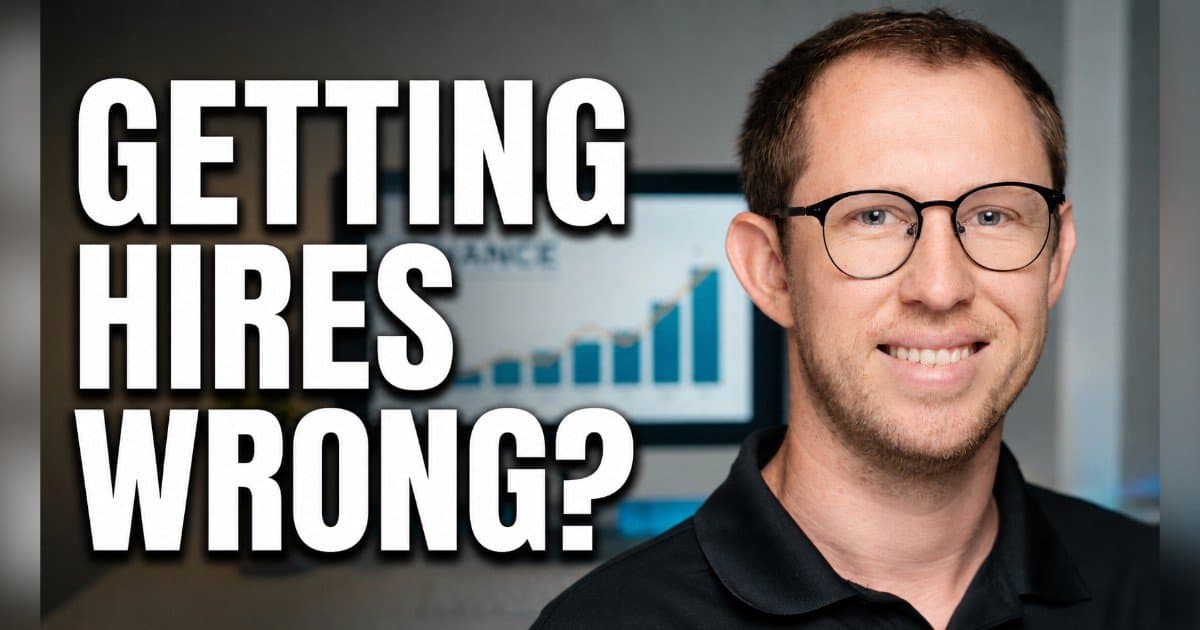
In a recent episode of The Building Texas Show, fractional CFO Bart Davis delivered a blunt message to startup founders: the first two hires after raising capital should be a controller and an HR leader, not product or go-to-market staff. Davis, founder and CEO of Austin-based 512Financial, argued that most Texas startups wait too long to professionalize their accounting, finance, and HR operations, a mistake that can derail a clean exit.
During the episode titled Fractional CFO: The 2 Hires Every Founder Gets Wrong Before Their Exit, hosted by Justin McKenzie, Davis drew on his experience running fractional finance across Joel Trammell's portfolio from 2014 to 2021. He pointed to Trammell's successful exits in 2018 and 2021 as evidence that early investment in the finance function directly shapes valuation. "He had been using a different outsourced accounting firm and what he referred to as the output was random number generator financial statements," Davis told McKenzie, warning that founders eyeing an exit cannot repair years of bad books on the way out the door.
The conversation, recorded virtually through Texas Venture Fest, explored the counterintuitive hiring order Trammell used when he first raised significant capital: a controller and an HR leader before product or go-to-market hires. Davis extended that logic to today's fractional market, arguing that founders often ask for a CFO when they actually need a staff accountant at roughly 20 percent of the cost. He called the mismatch "bringing a bazooka to a knife fight."
Davis also shared his rule that healthy startups should spend 2 to 4 percent of top-line revenue on the accounting and finance function. He cautioned against hiring a Fortune 500 or Global 1000 CFO for a company scaling from $1 million to $15 million in revenue, noting that such experience rarely translates. The episode further covered the 2025 acquisitions of Austin PeopleWorks and HireBetter.com, and the 'monetizing churn' thesis behind them, as well as the 1099 versus W-2 risk Davis says he sees regularly when onboarding new HR clients.
On the topic of AI, Davis noted that his team uses it daily but has inherited Claude-built financial models "riddled with errors" that only a trained CFO would catch. He advocated for an 80/20 framing: let humans drive the 20 percent of work that produces 80 percent of the value. The discussion challenges founders to confront "the things that make it real uncomfortable at night," underscoring the importance of early professionalization in a tightening capital environment.
The implications for HR vendors are significant. Davis's advice suggests a growing market for fractional HR leadership and outsourced HR services among startups that have traditionally underinvested in the function. As more founders heed this counsel, demand for HR technology and consulting that supports early-stage professionalization may rise. Vendors should consider tailoring solutions for startups at the $1 million to $15 million revenue range, where the need for scalable HR processes is acute. Additionally, the emphasis on compliance risks like 1099 misclassification points to opportunities for tools that help startups navigate worker classification. The Building Texas Show, hosted by Justin McKenzie, spotlights the founders, operators, and investors shaping the Texas economy. New episodes are available weekly on YouTube, Facebook, Instagram, LinkedIn, and all major podcast platforms.
