
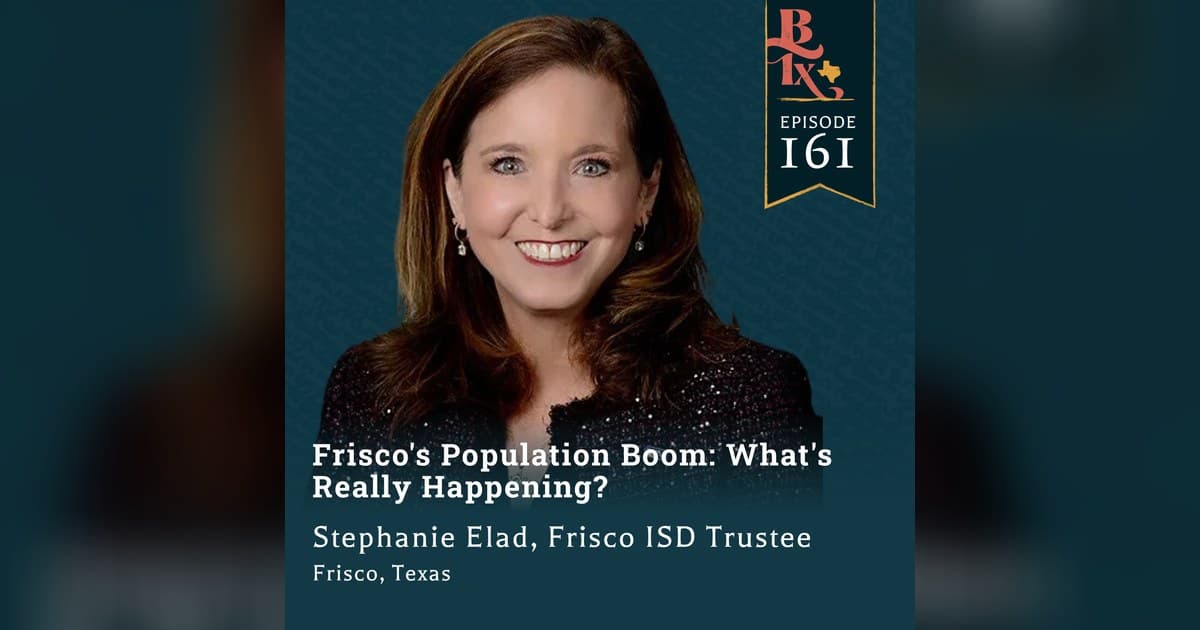
Frisco Independent School District, once a symbol of rapid growth in North Texas, is now confronting a new reality: it is landlocked, built out, and experiencing declining enrollment. In a recent episode of The Building Texas Show, host Justin McKenzie interviewed two-term Frisco ISD Trustee Stephanie Elad to explore the implications of this inflection point for teachers, families, and taxpayers.
Elad, a corporate HR executive who was reelected last year to a term through 2028, shared how her entry into public office was sparked by a controversial moment at an April 2021 board meeting. The board president at the time stated, "this is our meeting, not the community's," triggering a standing ovation and statewide press coverage. Elad recalled, "That just did not sit right with me. I didn't like it. And so I was sitting waiting for my turn to talk, and I realized that what I really wanted to talk about at that point was what he had just said." That moment spurred her 2022 campaign for the board.
With her HR background, Elad has focused on improving teacher retention. She brought a confidential, third-party employee engagement survey into the district to gather honest feedback from staff. "Tough conversations with staff and parents have never really been foreign to me because I've just been doing it for so long," she told McKenzie. This approach is critical for vendors selling HR solutions to school districts, as employee engagement tools and retention strategies are increasingly in demand.
The conversation also delved into workforce readiness and the stigma around trade careers. Elad noted that a neighbor who owns a plumbing business clears a couple hundred thousand dollars a year but cannot find apprentice plumbers. She argued that Frisco high schoolers should be able to enter apprenticeship programs earning $60,000 to $70,000 within a year or two of graduation, without debt or a four-year degree. The district is building plumbing, electrical, and HVAC apprenticeship pathways alongside existing CTE tracks like medical terminology, legal assistant work, and e-gaming.
McKenzie connected this to his advisory work with the startup Founding Up and to PTECH welding programs in the San Antonio area, where students graduate with as many as 60 college credit hours through community college partnerships. Elad emphasized preparing students for careers that AI cannot replace and urged families to vote in low-turnout school board elections.
For HR vendors, this shift highlights a growing market for workforce development tools, apprenticeship platforms, and career readiness programs. As school districts like Frisco ISD pivot to trade pathways, vendors offering solutions for CTE program management, employer partnerships, and student tracking may find new opportunities. Elad also expressed renewed optimism about the district's new superintendent, hired roughly a month before the taping, and the next chapter for Frisco ISD. The episode is available now wherever podcasts are heard.
This story matters because it signals a broader trend among suburban districts facing enrollment declines: a move away from traditional college-for-all models toward practical career pathways. For HR vendors, this means aligning products with district needs for employee retention, teacher engagement surveys, and CTE infrastructure. The emphasis on AI-proof careers also suggests a market for skills assessment and career counseling tools that help students navigate an evolving job landscape.
