
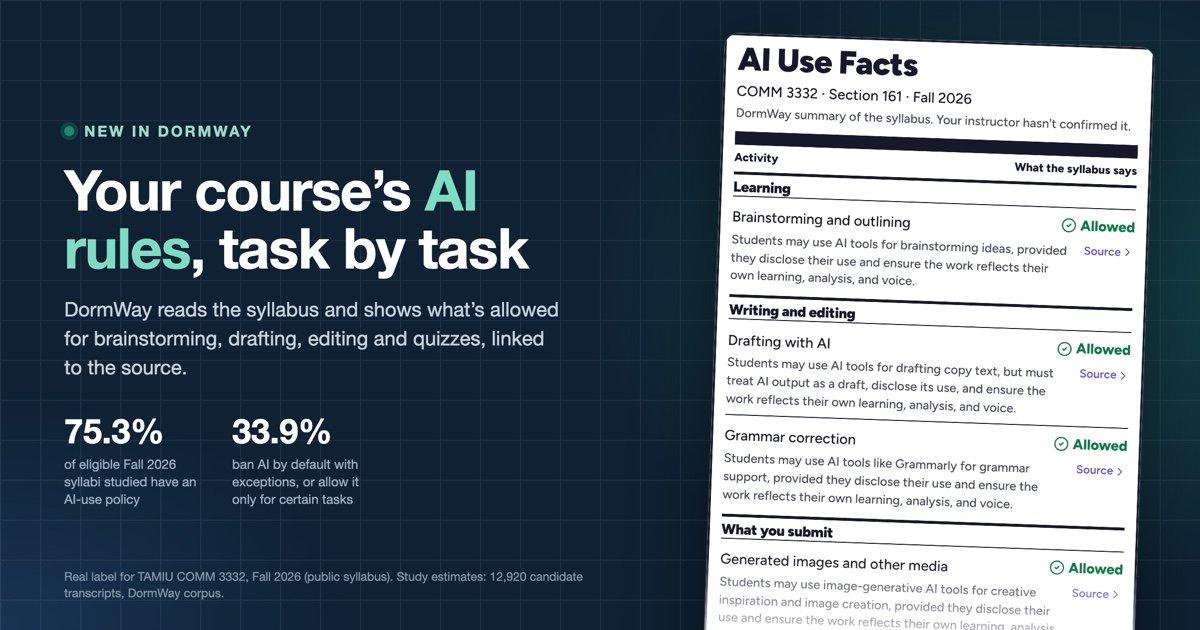
Student planner DormWay has introduced a Course AI Use Label that provides a consistent summary of whether artificial intelligence is permitted for studying, brainstorming, editing, submitted work, and exams, along with any approval and disclosure requirements. The label is generated automatically when a student adds a syllabus to the DormWay app, which reads the syllabus's AI rules and displays them on the course page, linked to the original document. The instructor's instructions remain authoritative, and the label is an automated summary rather than a replacement for official policy.
The announcement lands amid rising employer demand for AI skills. According to LinkedIn's 2026 report cited by DormWay, U.S. jobs requiring AI literacy grew 70% year over year. Yet students must still determine whether a specific use of AI is authorized for each assignment. DormWay's analysis of 12,920 candidate Fall 2026 syllabus transcripts estimates that 75.3% of eligible, policy-evaluable documents contain an operative AI-use policy. Among those, 33.9% use default prohibitions with exceptions or limit permission to specific tasks or assessments, while 11.7% contain mixed or unclear permission rules. The company notes these findings reflect its filtered transcript collection, not national college policy or student outcomes.
Official public Fall 2026 syllabi illustrate the varied decisions instructors make. Texas A&M International University's ENGL 3307 prohibits AI throughout its creative-writing process, including brainstorming and editing, while COMM 3332 encourages AI-assisted ideas, draft copy, and imagery under attribution and verification rules, but prohibits quiz use and direct pasting of AI-generated body copy. At UT Austin, CS 380I permits programming assistance while requiring students to understand and explain submissions, and its exams permit AI with disclosure of tools and affected questions. CS 439 treats generated code or text solutions as unauthorized unless explicitly permitted in writing. Even within a single syllabus, students may need to reconcile an allowance with a broader warning, as UT Austin's introductory CS 109 describes instructor-authorized AI use alongside general integrity restrictions on AI-generated assignments.
The stakes can be substantial: TAMIU's ACC 4370 specifies a course F and Honor Council referral for breaching its assessed-work AI restrictions. Acknowledging a tool does not override a prohibition or replace advance approval. The label uses task-level entries for studying, brainstorming, editing, generated submissions, and exams, with conditions for approval and disclosure, permitted tools, and a dated source. Missing information remains "not specified," and a label does not create permission. A companion seven-question checklist helps students check the instructions, and a free downloadable template lets faculty and students fill in the same label by hand.
"Students should be able to find the rules before they start an assignment," said Riley Crimmins, CEO and co-founder of DormWay. "A consistent label makes those expectations easier to check and helps students understand where responsible AI practice fits into their education. Instructors would continue to decide which uses support their teaching."
For HR technology vendors, the development signals that AI-usage norms are being formalized at the course level before students enter the workforce. Employers that screen for AI literacy may increasingly encounter candidates trained under explicit, documented rules governing disclosure and verification, which could shape expectations for AI governance training, assessment design, and compliance documentation in talent management platforms. DormWay's overview, research note, label template and student checklist provide confidence intervals, validation details, limitations, and links to the official course examples, while more information about the company is available at dormway.app.
